Biofilm Formation Occurs in Which of the Following Sequences
The PMC website is updating on 03212022. 2 Bacterial attachment Multiplication and Colonization.
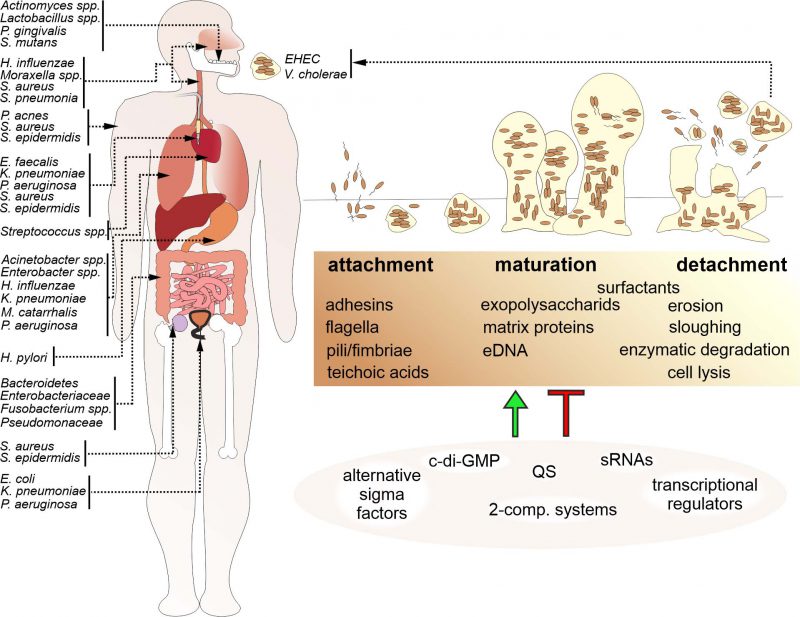
Biofilms By Bacterial Human Pathogens Clinical Relevance Development Composition And Regulation Therapeutical Strategies
The Bacterial Insertion Sequence Element IS256 Occurs Preferentially in Nosocomial Staphylococcus epidermidis Isolates.
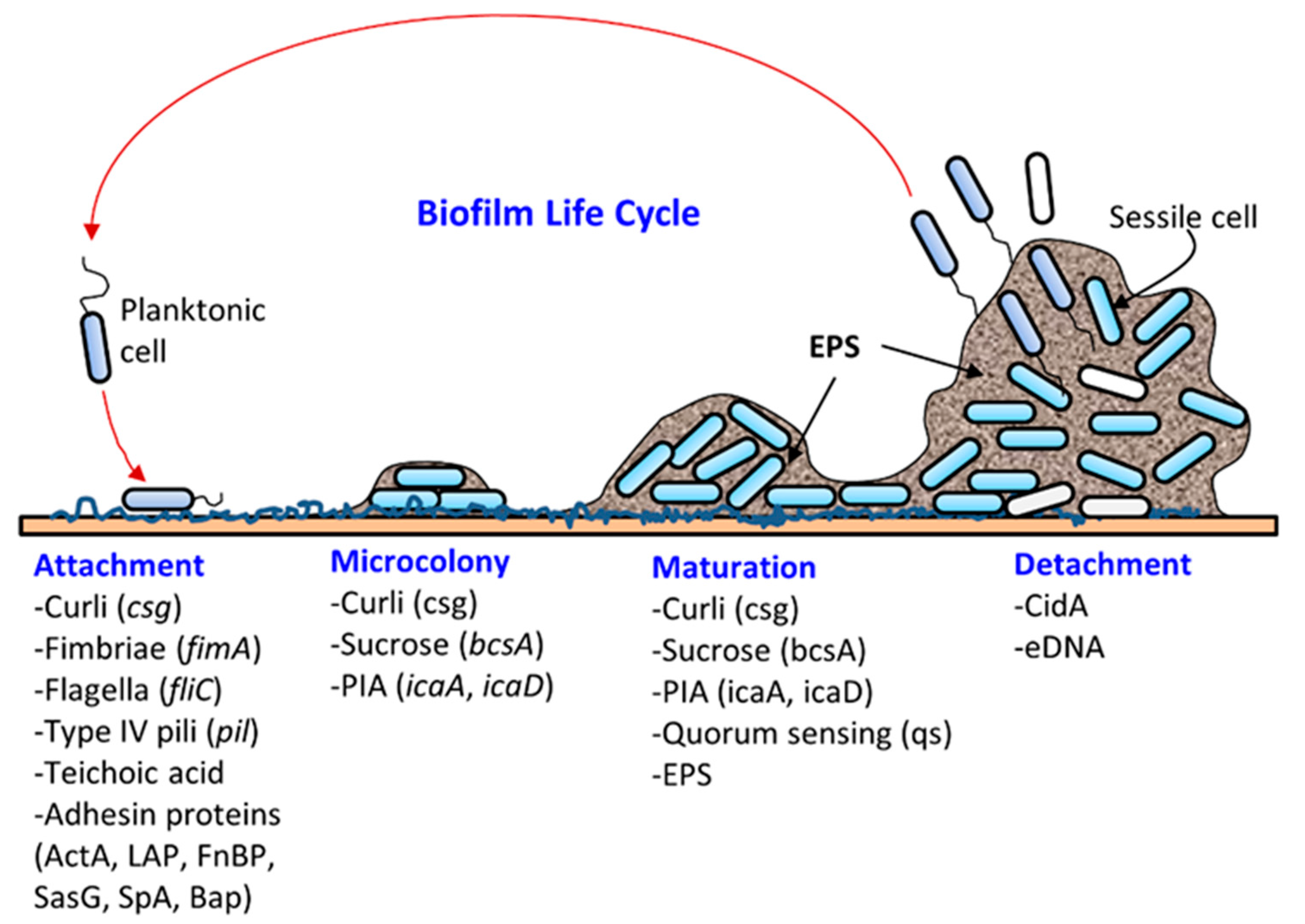
. Water channels begin to form. 1 Formation of pellicle. Because of this complexity the process of biofilm formation and its regulation is poorly understood.
Mainly there are 5 steps for the formation of biofilm as follows. Streptococcus mutans is recognized as the major oral cariogenic bacteria. Cells detach from the biofilm as a result of.
Explore the definition formation and survival of biofilms with examples of how they affect humans and surprising benefits. Biofilm formation in Pseudomonas aeruginosa is triggered by _____ cell densities and repressed by _____ cell densities. Biofilms have a propensity to act almost as filters to entrap particles of various kinds including minerals and host components such as fibrin RBCs and platelets.
Biofilm formation is a dynamic and complex process and includes initial attachment of cells to the substratum physiological changes within the organism multiplication of the cells to form microcolonies and eventually maturation of the biofilm. List the stages of Biofilm formation. Which of the following is the correct order of these stages.
Tetracycline also promotes the biofilm formation of the pathogen Acinetobacter baumannii and whole-genome sequence analysis revealed an increase in the rate of mutations such as SNPs as well as. Dental caries has plagued human beings for centuries. Cells attach to the surface.
Understanding the process of biofilm formation in Pseudomonas aeruginosa is. Biofilm formation as described for Pseudomonas aeruginosa in the introductory passage occurs in a series of steps. Furthermore genes encoding putative ABC transporter permease which can increase biofilm formation were also sequenced and annotated.
Biofilm formation begins with the adhesion of bacteria onto the electrode surface followed by the coadhesion and proliferation of microbial cells by the formation of multilayer cell clusters. Microorganisms which form biofilms are shown to elicit specific mechanisms. There are three stages of biofilm formation.
Mutans secretes glycosyltransferases GTFs which usually bind to the surface of tooth andor bacteria. One important virulence factor of S. Mutans is the formation of biofilms on tooth surfaces.
Which event occurs immediately before cells begin to signal to other cells within the biofilm. Colonizationattachmentdispersal and development 2. Cells break free to form new biofilms.
Both operons are under the control of. Staphylococcal biofilm formation is mainly mediated by the expression of the icaADBC operon which encodes enzymes for the production of the polysaccharide intercellular adhesin PIA 16 22. A detachment assay with NaIO 4 proteinase K or DNase was used to determine the main biofilm components.
Biofilm-associated genes including the ica operon were analyzed by PCR and. 3 Biofilm growth and maturation. Initial attachment microcolony formation and community development.
Try out this update now on PMC Labs or Learn more. There are four basic stages to biofilm formation. The bacterial insertion sequence element IS256 occurs preferentially in nosocomial Staphylococcus epidermidis isolates.
Cells produce gooey polysaccharide matrix. The first step in the biofilm formation process is bacterial adhesion to the host extracellular matrix and plasma proteins mediated by various proteins of the family of microbial surface components-recognizing adhesive matrix molecules MSCRAMMs. Biofilm-associated organisms grow more slowly than planktonic organisms probably because the cells are limited by nutrient andor oxygen depletion.
Describe what happens in stage 1 during the pellicle formation. Biofilms of Bacillus subtilis consist of long chains of cells that are held together in bundles by an extracellular matrix of exopolysaccharide and the protein TasA. Further the biopolymers produced by the microorganisms aid in encapsulating the biofilm leading to a structurally robust cellular assembly 28.
Development colonization attachment dispersal colonization attachment development dispersal attachment colonization development dispersal attachment development colonization dispersal. The following events occur in the formation of a biofilm. There are four basic stages to biofilm formation.
Bacterial biofilm is the slime found on a rock and even on teeth. Association with biofilm formation and resistance to aminoglycosides Infect Immun. Which of the following is the correct order of these stages.
-In response to the signal the planktonic cells begin to attach to nearby surfaces by means of flagella pili lipopolysaccharides or other appendages. A attachment colonization development dispersal B colonization attachment development dispersal C development colonization attachment dispersal D attachment development colonization dispersal. The aim of this study was to characterize S.
Biofilm formation has following important steps a attachment initially to a surface b formation of micro-colony c three dimensional structure formation d biofilm formation maturation and detachment dispersal 2. Previous studies have shown that IS256 can influence the expression of biofilm formation in S. Free-floating microorganism attaches to a solid substrate exposed in a moist environment through a weak Vander Waals force which is reversible.
Biofilm formation begins with the attachment. The first stage of biofilm formation occurs when a single environmental signal induces a genetic program in free living planktonic cells. Association with Biofilm Formation and Resistance to Aminoglycosides.
We analyzed the biofilm-forming capacities of 72 clinical S. The bacterial cells in biofilms therefore are metabolically distinct from their free-living forms. It is a hydrophobic alcohol that transports peptidoglycan precursors across the cytoplasmic membrane.
Use the information in the chapter to place the steps in the correct order from first to last. The exopolysaccharide is produced by enzymes encoded by the epsAO operon and the gene encoding TasA is located in the yqxMsipWtasA operon. IcaADBC detection biofilm formation and IS256.

Pf Phages Contribute To Biofilm Formation During The Early Stages Of Download Scientific Diagram
Steps Leading To Bacterial Biofilm Formation Adapted From 59 Download Scientific Diagram
Foods Free Full Text Bacterial Biofilms And Their Implications In Pathogenesis And Food Safety Html


Comments
Post a Comment